
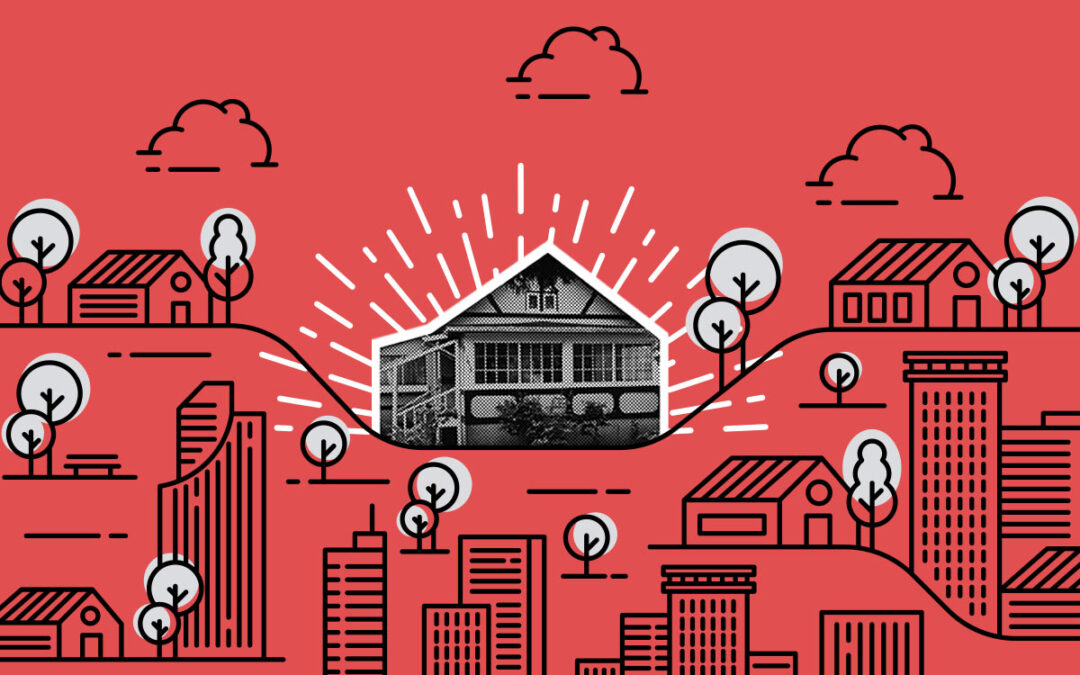
Here’s an article by Allen Garr from the Vancouver Courier. Allen came to the open house at Kogawa House on Sunday, September 17th. The Courier has written some great articles about Kogawa House and followed the campaign to save the house from demolition.
Kogawa house a new miracle
By Allen Garr
Published in Vancouver Courier on 09/20/2006
We tend to value things more when they are stolen from us. Quite ordinary things can become symbols of opportunities lost or injustices suffered. The rare occasion when they are recovered is cause for reflection and celebration.
The small bungalow at 1450 West 64th Ave. in Marpole was such a stolen item. It has no particular architectural importance. Most of the other houses like it in that neighbourhood were torn down years ago and replaced by Vancouver Specials. But it has an enduring quality.
At the beginning of the Second World War, the Nakayama family lived there: mom and dad with their daughter Joy and son Timothy.
Then came the war and Pearl Harbour and, as we all now know, hundreds of families like the Nakayamas were branded enemies of Canada, rounded up and evacuated from their homes. The Nakayamas were shipped to the B.C. interior.
Ralph Steeves says the day his “school chum” Joy disappeared from his life, he came home from lunch to find his mother in tears over what had happened.
His father, who headed a construction crew, was dispatched to the PNE grounds. His job was to convert the horse barns into stalls big enough to handle the Japanese-Canadian families until they were packed out of town. Steeves says when his dad realized what he was being asked to do, he walked off the job.
The small bungalow was sold for $1,400 and changed hands several times over the years. Joy eventually became a writer, married David Kogawa and moved to Toronto. But that building never left her thoughts.
Once as a teenager she wrote to the owners of the property. Could they tell her if the house ever came up for sale? She received no response. During the ’60s and ’70s, whenever she managed to get back to Vancouver, she would go by the house. There was a still a cherry tree in the back yard, the one she remembered as a child.
In 1981, Joy Kogawa’s novel Obasan was published. It was a fictionalized account of her life in that house and the years of displacement she and her family suffered through.
A decade later Kogawa was in the neighbourhood again and, this time, she knocked on the door. The owner invited her in for a tour.
Three years ago, a “for sale” sign turned up on the house. It was about to change hands again. Kogawa and her friends held a reading from Obasan in front of the building to say goodbye.
But it didn’t end there. A year ago the owners seemed intent on demolishing the building. The COPE council of the day moved a motion to delay the permit for 120 days and allow The Land Conservancy (TLC) to raise funds and buy the property. The building would be used to support a writer in residence to produce works dealing with injustice.
The owner was willing to co-operate. Enough money was raised. TLC now owns the property and last Sunday held an open house to celebrate. I arrived to find a diminutive Joy Kogawa, glasses perched well down her nose, leaning against a high table comparing notes with Shirley Zawalykut.
Zawalykut drove in from Delta after reading a Courier story reprinted in the Sun along with a photo of the house. “I told my husband: That’s my grandma’s house.” Zawalykut lived there too when she was a child in the ’50s.
Then I met Steeves, who pointed to a scar above his eye he got in a childhood game with his chum. He said he was mentioned in Obasan as the kid who taught Joy to light matches and just about burned the house down.
The cherry tree is still there at the yard at the edge of the lane and it’s in dreadful shape. It is diseased and split. A week ago a garbage truck ripped off one of the few remaining healthy branches. But a cutting was rooted and planted at city hall as a reminder of what was lost and what has been recovered.
“Just like a miracle,” Zawalykut called it.