
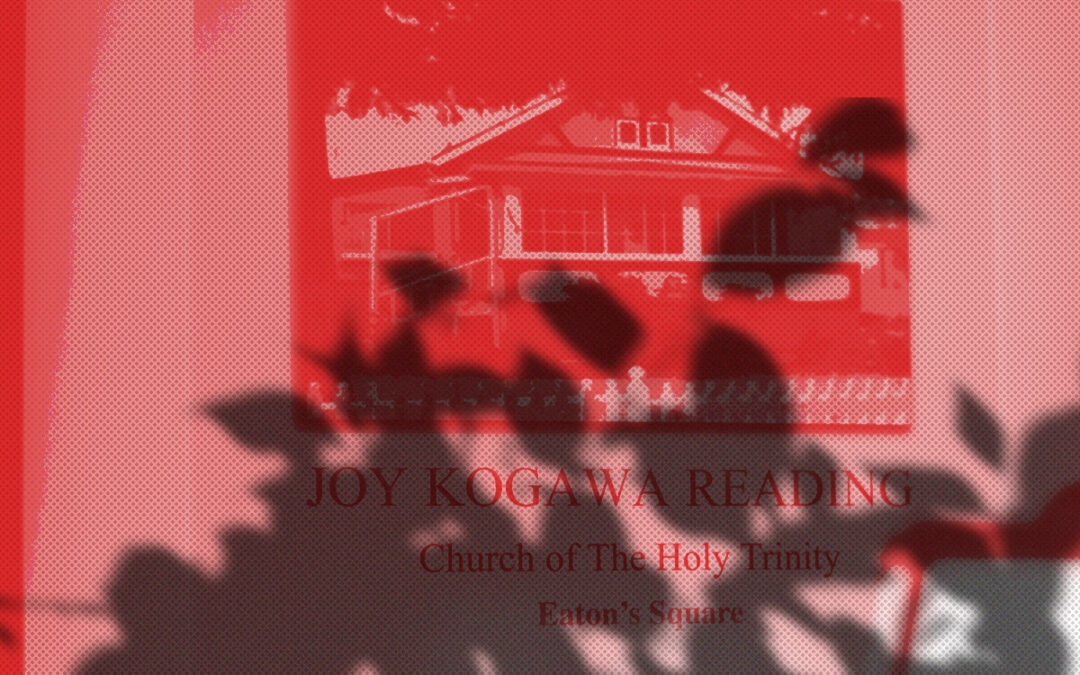
March 9 Joy Kogawa House Fundraiser in Toronto a Great Success
Report by Anton Wagner
Joy’s launch of her novel Emily Kato, combined with a fundraiser for the Joy Kogawa House, was an inspiring evening at the Church of the Holy Trinity, next to the Eaton Centre in downtown Toronto, on March 9. Nearly $9,000 was raised for the Land Conservancy of B.C.’s Joy Kogawa House rescue drive. About 150 people attended the event organized by Anton Wagner, Secretary of the Joy Kogawa House Committee.
The evening was scheduled to begin at 5 pm. Fortunately, Save Joy Kogawa House Committee member Tomoko Makabe suggested we should start selling books already at 4:40 so that those coming early could purchase copies of Emily Kato and Obasan and have Joy inscribe them. There was still a line-up as concert pianist William Aide began the evening half an hour later with a beautifully serene classical composition.
The Reverend Sara Boyles welcomed the audience and spoke of the tradition of social justice at the Church of the Holy Trinity, founded in 1847 for Toronto’s poor immigrants, and that the Churches were continuing to stand with the homeless, dispossessed, and people excluded from Canadian society.
Michael Creal, former head of humanities at York University, reminded the audience of the forced evacuations and internments of 22,000 Japanese Canadians under the War Measures Act in 1942 and of the importance of Joy’s Obasan in expressing the suffering these government injustices inflicted on the Japanese Canadian community. He recalled that he taught Obasan at York University in the early 1980s and that his students didn’t know what had been done to Japanese Canadians during World War II. Michael described the very important public meeting at the Church of the Holy Trinity in 1984 that led to the Toronto Ad Hoc Committee on Redress and helped to make redress a national issue. He then introduced Joy.
Joy spoke of her childhood home in Vancouver that is now under threat of demolition and read the description of the house from Obasan. She then read from Emily Kato, including chapter 22 set in the Church of the Holy Trinity, one of the many locales where organizing for redress took place. Joy recalled that it felt like a miracle when she came across her childhood home in Vancouver again in 2003 and that it continues to be a miracle that the house is still standing. She also described her encounter, in the garden of the house, with the cherry tree which was subsequently severely pruned and may be dying.
“I felt when I was there, in all its woundedness, that somehow in the universe we are known, our wounds are known. And I had the strange sense that this knowing, this knowing of the community, this knowing of the family, that when we are known we are healed. I felt that healing welling up within me at the tree. So for me that spot became holy ground. It was my small portal to messages that we are known. And I just felt that healing.” Referring to the new novel she has begun to write, Joy concluded, “My dream is that I will be able to write Gently to Nagasaki with instructions that will come to me through the portal of that tree. That is my dream.”
Bill Turner, Executive Director of The Land Conservancy of B.C., then spoke of the necessity of saving the Joy Kogawa House as a permanent reminder of historical events that must never be repeated and asked those present to assist in the drive to save the House from demolition. “The House is a symbol of a time and a reminder when ordinary Canadians were removed from their homes and interned. We want to save this house as a reminder of that. We want to save this house so that it can become a place of happiness again, a symbol of peace and hope and reconciliation. We must not forget what happened in those years, and it’s easy to do so. It’s easy to forget.” Bill expressed his optimism that the $700,000 required to purchase the House from its present owner could be raised with Canada-wide support.
“The Joy Kogawa House is of national importance,” he stated. “As those of us who are now here die and move on, we must preserve these places so that our children and grandchildren can learn what happened. In a society that doesn’t remember and recognize its mistakes, they can continue to happen. An injustice to one is an injustice to all.”
Joy’s dream, of course, is also that other writers will be able to come and stay and write in the Joy Kogawa House. Ron Brown, First Vice-Chair of the Writers Union of Canada, was the first speaker representing the dozen writers’ organizations that have backed saving the Kogawa House. He recalled that Groucho Marx once said that he would never belong to an organization that would have him as a member. “Well, 1,500 members of the Writers’ Union of Canada are absolutely delighted to belong to an organization that can claim Joy Kogawa as a member. You have written so passionately about an unpleasant reality,” Brown stated.
“You have arrived at an interesting moment in Ontario. We are experiencing a controversy about an attempt to censor a book about another unpleasant reality. The book is called Three Wishes. It was written by Deborah Ellis, one of our members, and includes interviews with Israeli and Palestinian children who express their fears and wishes about the conflict there. Some of those views are disturbing to some. A teacher near Toronto objected that the contents do not adequately reflect the Israeli point of view, and an organized effort was launched to have school boards across Ontario remove the book from their silver birch award reading list. A few have done just that.”
“Canada has faced a number of unpleasant realities. The extermination of the Beothuks in Newfoundland, the expulsion of the Acadians from New Brunswick, the long standing mistreatment of our First Nations people, and the reality which you, Joy, have written about. But unlike most other books written about these realities, Joy brings together three things which the others do not. Not only has she written about this reality, but she has experienced it herself, and third, the Kogawa House still stands as a physical legacy of that dreadful time.”
“This is why I find it distressing that the house is facing the threat of demolition. I write about heritage buildings and have seen too many demolished. Those with negative connotations especially. It seems that in Canada it’s what we do. And that is why I find it even more distressing that Canada’s heritage minister has declined to provide funds to help save the house, despite a written pledge from the federal government that it will do everything in its power to ensure that such atrocities will never recur. Talk about not putting their money where their mouth is.”
“But it is encouraging to see so much support here tonight for saving the house, support that the Writers’ Union is happy to share. But as Joy said in the Globe this morning, there is not much time left.”
“As with the book Three Wishes, to destroy the Kogawa House would be much like censoring reality. In Canada we should be confronting our realities, not censoring them. Saving the Kogawa House will serve as a visible reminder of one unpleasant reality. So, let’s save the house and help make Joy’s dream come true.”

March 9th, Toronto, Michael Creal

March 9th, Toronto, Joy Kogawa raises her hands to make a point.

March 9, Toronto, Bill Turner

March 9th, Toronto, Ron Brown

March 9, Toronto, Mary Ellen Csamer – with Bill Turner and Joy Kogawa in background

March 9th, Toronto, Philip Adams

March 9th, Toronto, Joseph Levy, with Bill Turner behind him

March 9th, Toronto, Ben Antao

March 9, Toronto, William Aide concert pianist

March 9th, Toronto, Tomoko Makage sells books for the Emily Kato launch

March 9, Toronto, Lynn McDonald with Joy Kogawa

March 9th, Toronto: Professors Joseph Levy and Kym Bird of the York University Faculty Assoc. with Bill Turner and Anton Wagner

March 9, Toronto, Derry Poster with Joy Kogawa
In her address, Mary Ellen Csamer, President of the League of Canadian Poets, stated: “As writers, artists, we are both witnesses to and participants in our times. Sometimes, as now, our shared responsibility is to act as an amplifier for those voices who can best speak to specific actions of the body politic, done purportedly on our behalf. Joy Kowaga’s intelligent passionate voice has added to the sum of our witnessing, to the collective ‘no’ of our resistance to our own fear-based tyranny.”
She added that “It saddens me that our Federal Government has no program in place to protect our historical and literary heritage. The Joy Kogawa House represents the struggle for Home. It is not real estate, it is the real estate of our collective need to create and nurture community so that we can learn to live without fear of each other. To create this writers-in-residence, historic centre in the City of Vancouver would express on behalf of all Canadians our deep desire to redress the wrongs of the past and celebrate once again our rich and diverse cultural community. On behalf of the League of Canadian Poets, and its 700 members, I urge the Federal Government to provide the necessary fund to help us to save the Joy Kogawa House.”
Philip Adams next spoke on behalf of two organizations as Coordinator of the Readers & Writers program for PEN Canada and as Treasurer of the Playwrights Guild of Canada. “The Playwrights Guild of Canada has over 800 members who are for the most part desperate for a time and place to write and it is our hope that one or many of them may be allowed the opportunity to do that in the Joy Kogawa House. PEN Canada fights for freedom of expression around the world and particularly here in Canada. There are many exiles here in Canada as well. The First Nations certainly have reason to feel exiled, the Japanese Canadians have been exiled, and many people from other countries who are here now continue to feel in exile. Again it is PEN Canada’s hope and dream that perhaps someday soon such writers will be able to take up residency in Vancouver.”
Dr. Joseph Levy, Vice-President, External, of the York University Faculty Association, explained that his field of health sciences is really about healing and that this evening had been an evening about healing. “We must say to ourselves that we never want this to happen again in Canada but we also don’t want this to happen again in Somalia, in Afghanistan, in Romania or anywhere else in the world where this could possibly happen. So I see this project as being not only for our fellow Canadians who were interned during the war but I also see this project as symbolic of something that will allow all of us to continue working around the world so that this kind of event, this atrocious, despicable way of treating citizens in their own country, should never happen again. But let me remind you that it is happening at this moment all over the world.”
Dr. Levy then presented a $1,000 contribution from the York University Faculty Association to Bill Turner for the Land Conservancy Joy Kogawa House fundraising drive and challenged other universities across Canada to match YUFA’s donation.
Ben Antao, President of the Toronto Branch of the Canadian Authors Association, also brought a donation from his organization. (The CAA awarded Obasan its Book of the Year Award when it was first published in 1981.) “Heritage properties of writers and artists help to enrich the cultural mosaic that is Canada,” Antao stated. “I haven’t seen Joy Kogawa’s childhood home in Vancouver but I have read her novel Obasan and the book describes her house and illuminates a dark chapter in the developing history of Canada and her people.”
Following these presentations, William Aide again played the piano, Joy inscribed more books and many in the audience spoke with Bill Turner about saving the Kogawa House and made personal donations.
There was much-animated conversation as the audience enjoyed the delicious food and refreshments provided by members of the Church of the Holy Trinity congregation and organized by its Social Justice Committee.